The presence of Artificial Intelligence (AI) has become inevitable for the business world, including the national logistics and supply chain sector. A McKinsey study states that the use of AI in the logistics and supply chain sector can increase logistics cost efficiency by up to 15%. With AI’s role becoming increasingly inevitable, this can be a momentum for Indonesia’s logistics and supply chain sector to reduce high national logistics costs and improve the competitiveness of domestic industry.
Therefore, the ALFI Institute believes that this must be supported through collaboration between the government and national logistics supply chain businesses.
Overcoming Operational Technical Barriers
Today, the global logistics and supply chain sector is facing AI that accelerates and transforms operations. AI has also proven to help overcome various technical and strategic obstacles in business operations. Globally, 72% of logistics and supply chain companies have adopted AI in their operations.
A recent report from global marketing and research firm Gitnux found that many global companies use AI in their operations, including to improve time efficiency and reduce logistics costs, demand forecasting and strategic planning based on market data and trends, travel management and fleet maintenance, and customer service automation. This has further proven to enhance corporate competitiveness and reduce operational costs.
AI adoption in global logistics and supply chains signals that AI’s benefits are unavoidable. For business players, decision-making in the logistics and supply chain sector has become more complex, unsustainable, and full of uncertainty. Moreover, disruptions from post-trade-war changes and global geopolitical tensions often reset the global logistics and supply chain order. In this context, AI helps businesses understand the current landscape and make more accurate business decisions.
Lessons from China
China is the country with the world’s largest logistics market, based on logistics business fundamentals, logistics infrastructure, distribution networks, and digitalized facility capacity. According to the China Federation of Logistics and Purchasing, China’s logistics and supply chain sector ranks first with a total market share of US$50 trillion, and the sector’s growth is accompanied by AI adoption.
What makes China’s logistics and supply chain sector more competitive than other countries is the size of its market and the contribution of ‘smart logistics’. Simply put, smart logistics refers to the integration of AI, automation, and big data to improve supply chain efficiency. Its implementation includes warehousing, transportation, and supply chain management.
Alibaba, through its logistics subsidiary Cainiao, has become a market leader in implementing smart logistics in China. Cainiao employs more than 700 robots for warehouse management, and these AI-powered robots ensure domestic deliveries within 24 hours and international deliveries in under 72 hours. This has revolutionized global logistics practices.
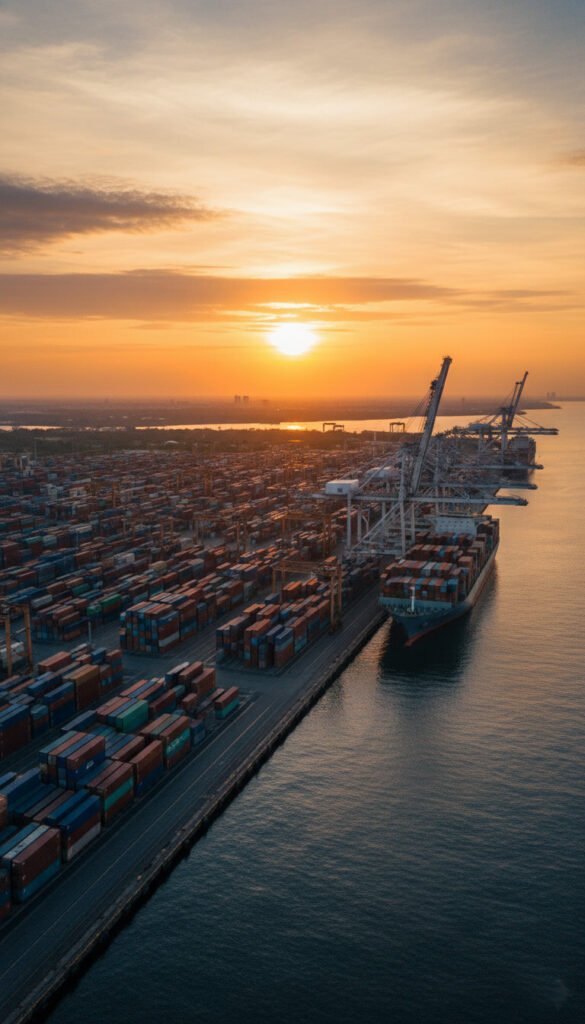
Moreover, during my recent visit to China, AI, automation, and big data were also observed at major ports. Ports and docks in major Chinese cities use unmanned vehicles for cargo management, reducing dependence on human labor, which improves dwelling time and cargo handling efficiency. Additionally, other major ports in China have adopted AI DeepSeek models to optimize container verification, customer service, and fleet management.
Today’s landscape of China’s logistics and supply chain sector is the result of the government’s commitment to serious investment in the sector. In terms of investment, the Chinese government has spent more than US$29 trillion on logistics to remain competitive through AI adoption.
What About Indonesia?
Indonesia has a big task in improving its national logistics and supply chain sector. Although infrastructure and licensing have improved, Indonesia logistics still needs to be more competitive compared to other regional countries.
One “game changer” to increase the competitiveness of Indonesia’s logistics and supply chain sector is accelerating AI adoption in the sector and national industries. This requires national leadership committed to realizing this vision. Learning from China, government leadership in driving AI adoption is necessary so that business players feel confident to make a similar transition.
Not only is large investment needed to build smart logistics infrastructure, but also a combination of policies, regulations, and efforts to maintain a conducive business climate so AI adoption can succeed in the national logistics and supply chain sector. Public-private partnerships are also essential to support the successful transformation.
Now is an important momentum for AI adoption in the logistics and supply chain sector so that it can be integrated into the global trade order after the tariff war. Most importantly, AI acceleration will help the sector contribute more to President Prabowo’s target of 8% economic growth.